Strategic Legacy & Key Figures
The K-Neutrality Initiative (KNI) is rooted in a centuries-long pursuit of strategic autonomy. Our mission draws inspiration from the visionary leaders and pivotal moments in Korean history that sought to position the peninsula as a bridge of peace rather than a theater of conflict.
The Foundations of Sovereignty
- Kim Ku (Baekbeom): As the leader of the Provisional Government, Kim Ku envisioned a "Beautiful Nation" defined by cultural depth and an independent spirit. His post-1945 efforts to prevent the permanent division of the peninsula remain the moral compass for KNI’s pursuit of a unified, neutral future.
- The March 1st Movement Legacy: Our initiative honors the spirit of 1919, where a unified people demanded the right to self-determination. This "Civil Sovereignty" is the bedrock of our belief that Korea’s neutrality must be a choice made by its people, for its people.
The Evolution of Strategic Autonomy
- The "Balanced Diplomacy" Tradition: We look to the pragmatic legacies of the late Joseon era and into the modern era, honoring those who prioritized the national interest over bloc-based ideologies. By synthesizing historical statecraft with contemporary realism, we advocate for a Korea that is sovereign, secure, and neutral.
Our Strategic DNA: The Daedong (Grand Unity) Philosophy
While our strategy is shaped by history, our core values are encoded in the ancient Korean ideal of Daedong (대동, 大同). This "Grand Unity" is the philosophical engine that drives the K-Neutrality Initiative.
"A world where the spirit of public good prevails, and no one is left behind."
Why Daedong is the Blueprint for Neutrality
The Daedong philosophy is not merely about domestic harmony; it is a worldview that rejects "us vs. them" binaries in favor of a Great Equilibrium.
- From Conflict to Coexistence: Daedong teaches that true security comes from a state of "Grand Unity," in which neighbors are partners rather than rivals. Neutrality is the modern political mechanism we use to achieve this ancient ideal.
- Korea as the "Global Hub": Just as Daedong seeks to harmonize diverse elements within society, a neutral Korea acts as a geopolitical balancer, harmonizing the interests of global powers to ensure regional stability.
- The Public Interest (Gong, 公): Neutrality removes Korea from the private interests of external superpowers and refocuses the state on the Public Good—the safety and prosperity of the Korean people and the global community.
The Spirit of Our Mission: Life-Motherhood (생명모성)
At the core of our initiative is a profound shift in how we view the world. While The Framework provides the diplomatic "Body" of our strategy, Life-Motherhood is its "Soul".
In an era defined by conflict and ideological division, we look toward a deeper, universal energy—the instinct to nurture, protect, and take ultimate responsibility for all living beings. This is not merely a feminine trait or a family bond; it is the fundamental cosmic force that prioritizes the preservation of life over the victory of any single ideology.
By rediscovering this "Motherhood of Life," we find the strength to heal the wounds of national division and move toward a truly neutral, peaceful future for the Korean Peninsula.
Explore the principles of Life-Motherhood through the questions and answers below. (See Below)
From Spirit to Action: The K-Neutrality Initiative
The philosophy of Life-Motherhood is not merely a concept for reflection, but the vital spark that ignites our organized mission. To protect the sanctity of life on the Korean Peninsula, this spirit must be translated into a dedicated movement—The Initiative—which serves as the operational vehicle for realizing a peaceful, neutral future.
The Synthesis: From Inner Values to Global Peace
Our philosophy, "Life-Maternism," is rooted in Life-Motherhood—a profound reverence for all living beings. This nurturing foundation finds its ultimate fulfillment in the spirit of Hongik Ingan: the timeless commitment to broadly benefit all humanity.
The Vital Spark and the Operational Vehicle
- Life-Motherhood as the Vital Spark: This philosophy is the creative force that prioritizes the preservation of life over ideological victory. It provides the moral energy required to heal national division and move toward a peaceful future.
- The Initiative as the Operational Vehicle: To protect the sanctity of life on the Korean Peninsula, this inner spirit must be translated into a dedicated movement. The K-Neutrality Initiative serves as the practical vessel for realizing this vision.
- A Modern Manifestation: We do not view neutrality as a passive withdrawal, but as an active devotion to the welfare of mankind. By establishing Korea as a neutral bridge, we fulfill our inherent Hongik Ingan spirit—ensuring that our strategic autonomy serves the greater good of the global community.
FAQ: Understanding Life-Motherhood
1. What is Life-Motherhood?
Life-Motherhood is the fundamental cosmic force that brings all life into existence, nurtures it, heals it, and takes ultimate responsibility for it. It transcends the biological nature of a mother; it is a universal energy dedicated to respecting and reviving life itself.
2. Is this force also present in animals?
Yes. We see the roots of Life-Motherhood in the instincts of animals that risk their lives to protect their young. However, human Life-Motherhood is unique because we can consciously expand this instinct to care for others, society, and the entire planet through "conscious compassion".
3. Is it primarily a feminine trait?
While we use the word "Motherhood," it is not exclusive to women. It refers to the universal nature of birthing and nurturing. At its core is the heart that warmly embraces others and prioritizes life above all else, regardless of gender.
4. Why is the word "Life" attached to "Motherhood"?
Traditional "motherhood" is often perceived in a closed sense—caring only for one’s own family. By adding "Life," we emphasize a universal value that treats all living beings equally and with dignity, transcending bloodlines and borders.
5. Is it related to "Hongik Ingan" (Broadly Benefiting Humanity)?
They are deeply connected. The spirit of Hongik Ingan is the practical expression of Life-Motherhood. If Life-Motherhood is the "root" of the heart, Hongik Ingan is the "activity" that blooms from that root.
6. Can it be a keyword for our modern era?
Absolutely. In a society plagued by conflict and environmental crises, Life-Motherhood—which values inclusion over confrontation and healing over destruction—is the essential spirit and alternative value system our time needs.
7. Is it a Mantra?
While not a traditional religious spell, reflecting on this word to find your center acts as a healing mantra for self-purification. It has the power to calm the mind and awaken one’s internal vital energy.
8. Is it found only in women?
No. Life-Motherhood is inherent in both men and women. The desire to care for others, empathize with suffering, and pursue peace is the expression of Life-Motherhood within any individual.
9. Aren't "Motherhood" and "Life" the same thing?
They are similar but have different nuances. "Life" is the phenomenon of existence, while "Motherhood" is the active attitude of maintaining and nurturing that life. Together, "Life-Motherhood" means an active love that allows life to flourish as it should.
10. Can it be learned?
Yes. It is not about memorizing knowledge; it is attained by discovering the compassion already within yourself and practicing empathy. It is a process of "mind-study" and character building.
11. Is it different from "Love"?
Life-Motherhood is the deepest and most sublime form of love. While general love can sometimes be possessive, Life-Motherhood is closer to "unconditional devotion"—the act of reviving life without expecting anything in return.
12. Is it a religious activity?
It is not limited to any specific religion. It is a universal human ethic and philosophy of living. While it aligns with the "mercy" or "love" emphasized by many faiths, it is best understood as a spiritual attitude rooted in our daily lives.
Official Correspondence: Prof. Dr. Heinz Gärtner on K-Neutrality
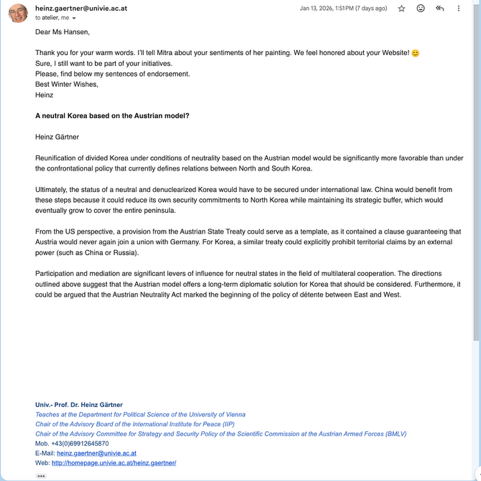
On January 13, 2026, Prof. Heinz Gärtner, a global authority on neutrality, shared his strategic insights regarding the applicability of the Austrian model to the Korean Peninsula. Below is the full text of his analysis.
The Austrian Model for Korea
"The reunification of a divided Korea under conditions of neutrality based on the Austrian model would be significantly more favorable... than the confrontational policy that currently defines relations."
Prof. Dr. Heinz Gärtner University of Vienna / International Institute for Peace (IIP)
Key Insights from the Endorsement:
- International Law: A neutral and denuclearized Korea must be secured under international law to ensure lasting stability.
- The Austrian Template: Provisions from the Austrian State Treaty could serve as a template to prohibit territorial claims by external powers such as China or Russia.
- Strategic Buffer: Neutrality would allow China to reduce its security commitments to North Korea while maintaining a strategic buffer across the entire peninsula.
- Diplomatic Solution: The Austrian model offers a long-term diplomatic solution that could mark the beginning of a new era of détente.
[Source: Excerpt from personal correspondence with Heinz Gärtner, January 13, 2026]
Core Content:
Subject: A neutral Korea based on the Austrian model?
- Heinz Gärtner
"The reunification of a divided Korea under conditions of neutrality based on the Austrian model would be significantly more favorable for the international community and the Korean people than the confrontational policy that currently defines relations between North and South Korea.
A neutral and denuclearized status of a unified Korea must be secured under international law. The provisions of the Austrian State Treaty of 1955 can serve as a template here. Such a treaty would prohibit any territorial or political claims by external powers, such as China or Russia.
For China, neutrality would mean that it could reduce its security commitments to North Korea while at the same time maintaining a strategic buffer across the entire peninsula. The Austrian model offers a long-term diplomatic solution that could mark the beginning of a new era of détente on the Korean Peninsula."